Crimean Bridge Damage Deepens Russia’s Infrastructure and Logistics Risk
Zelensky described the bridge as a legitimate military target as extensive damage left repair costs and completion timelines uncertain.
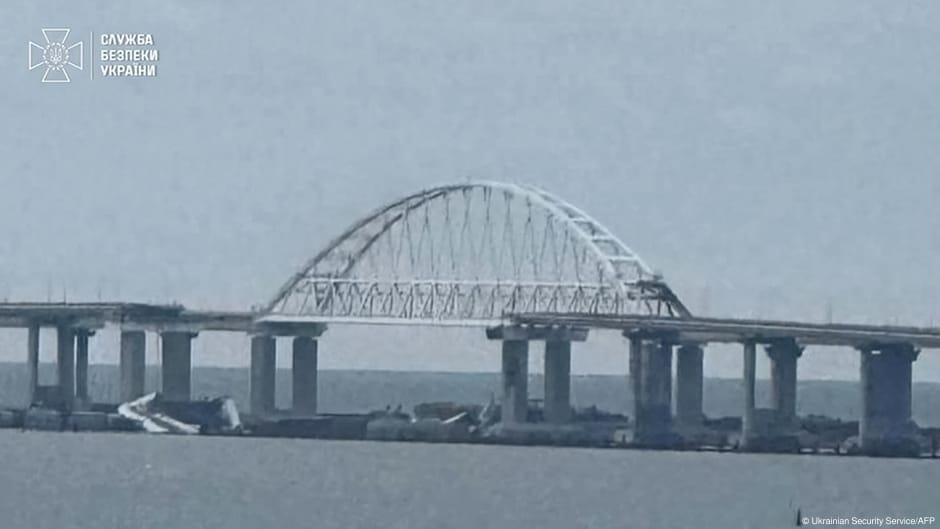
Damage to the Crimean Bridge has created a significant infrastructure liability for Russia, with repair costs, engineering requirements and restoration timelines still undetermined after a series of Ukrainian strikes. Ukrainian President Volodymyr Zelensky said in an interview with NBC News on Friday evening, November 20, that the bridge would not survive because Kyiv considers it a legitimate target.
The bridge crosses the Kerch Strait and connects Russia with Crimea, which Moscow annexed after occupying the Ukrainian peninsula in 2014. Zelensky argued that Ukraine is responding to Russian aggression and would not accept continued Russian control of the territory, whether the dispute is ultimately resolved through diplomacy or military action.
“Putin must understand that this bridge will not survive,” Zelensky said.
Zelensky said Russia had occupied Ukrainian territory, built the bridge and declared it part of Russia. He also pointed to Moscow’s subsequent changes to its constitution and domestic laws as an attempt to formalize its control over Ukrainian territories. Those actions have not received international recognition, he said.
Repair Schedule Remains Unclear
The latest reported damage raises questions about the scale of the repair program that Russia may need to finance and the length of time during which traffic capacity could remain constrained. Occupation authorities in Crimea reported a strike on the bridge on the morning of November 16 and restricted vehicle traffic. A day later, reports said one of the bridge’s arches and part of the roadway had collapsed into the sea following another strike.
The railway section was targeted during the night of November 19 and is now heavily damaged, according to the source account. Russian Deputy Prime Minister Marat Khusnullin said on November 20 that Ukrainian strikes had damaged the main beam of the arch span as well as the arch itself.
Khusnullin said potential restoration dates were unknown and could be established only after engineers produced design solutions. His comments indicate that the project had not yet reached a stage at which Russian authorities could provide a firm construction timetable or define the full scope of work. No official repair budget, loss estimate or financing plan was disclosed.
Russian authorities had said a day earlier that train traffic across the bridge had resumed after the attacks. Khusnullin initially suggested that a more reliable estimate of the restoration schedule could be available within a week. He said certain elements might be put back into operation within one or two months, while the remaining work would depend on further assessments. Storm conditions were also complicating the evaluation.
The partial resumption of railway operations does not resolve the longer-term financial and logistical exposure. The bridge supports both road and rail traffic, and damage to separate structural components may require distinct engineering, procurement and installation programs. Until technical designs are completed, the potential effect on public spending and construction resources cannot be quantified from the information released.
Independent Estimate Points to Multiyear Work
Andriy Koretskyi, an associate professor in the department of bridges, tunnels and hydraulic structures at Kyiv’s National Transport University, estimated that restoration could take between 1.5 and three years. He said manufacturing an arch alone would require about a year, after which it would have to be assembled at a work site, transported and installed.
Koretskyi also questioned whether Russia would be able to complete another arch installation near Ukraine’s border without further disruption. His estimate differs substantially from the shorter timeframe mentioned for restoring individual elements, underscoring the uncertainty surrounding full reconstruction rather than limited operational repairs.
For financial reporting purposes, the gap between temporary service restoration and complete structural recovery is material. Limited train operations may preserve some transport capacity, but they do not establish that the asset has returned to its previous condition or that future expenditures will be modest. The absence of an approved engineering solution also prevents a dependable assessment of project cost, completion risk or potential overruns.
Military Role Adds Continuing Asset Risk
Zelensky indicated that strikes on the bridge could continue. He said Russia should experience the consequences of the war and understand that it cannot retain control over the Ukrainian peninsula. He also said Ukraine had responded after Russia attacked several Ukrainian facilities, including with a strike on the Crimean Bridge.
According to Zelensky, Russia continues to use the bridge to transfer as many weapons as possible to Crimea. Daily reports from the Ukrainian Armed Forces frequently describe missile and unmanned aerial vehicle launches originating from the annexed peninsula.
That military function increases the likelihood that the bridge will remain exposed even if emergency repairs restore portions of its capacity. From an infrastructure and balance-sheet perspective, repeated attacks could shorten the useful life of repairs, raise security and construction costs, and make completion schedules more difficult to forecast. However, neither Russian nor Ukrainian officials provided monetary estimates for the damage or the expected reconstruction program.
The immediate financial picture therefore remains defined by uncertainty: a strategically important transport asset has sustained confirmed structural damage, railway service has reportedly resumed, and officials are awaiting engineering plans before setting a restoration schedule. Zelensky’s statement that Ukraine will not accept the occupation, combined with his indication that attacks may continue, leaves Russia facing an open-ended repair obligation rather than a clearly bounded reconstruction project.



