EU Commission Seeks Bulgaria Fine as Budget Deficit Widens to 5%
Brussels says Bulgaria failed to curb its fiscal shortfall, potentially making it the first EU member fined for excessive spending.
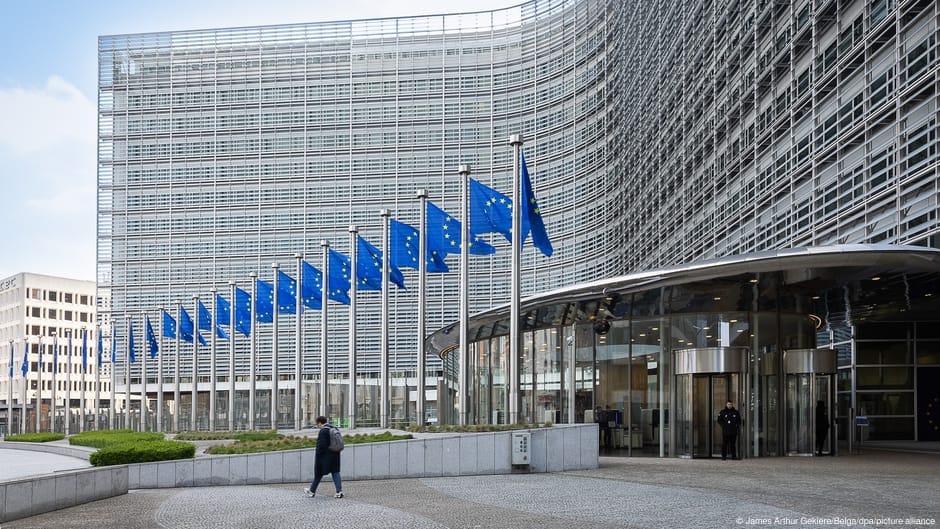
The European Commission intends to ask European Union finance ministers to impose a financial penalty on Bulgaria after concluding that the country has failed to take sufficient action to reduce its widening budget deficit.
The Commission announced the planned request on Tuesday, November 24, under the EU’s Excessive Deficit Procedure, or EDP. It also signaled that it wants tougher measures against Hungary, which Brussels says has likewise failed to implement the necessary fiscal corrections.
Bulgaria’s general government deficit is expected to reach 5% of gross domestic product in the current year, according to Commission calculations. That would put the country two percentage points above the EU’s 3% deficit ceiling and continue a deterioration from 3% of GDP in 2024 and 4% in 2025.
If EU finance ministers approve the Commission’s proposal, Bulgaria would become the first member state to face a monetary fine for excessive expenditure under the bloc’s fiscal enforcement framework.
Fine could be repeated every six months
Under EU rules, Bulgaria could be fined an amount equal to 0.02% of its GDP in the previous year. The source figures do not provide a monetary estimate for the penalty, but the GDP-linked formula makes its size dependent on Bulgaria’s reported annual economic output.
The sanction would not necessarily be a one-off charge. It could be imposed again every six months until EU finance ministers determine that Bulgaria has taken effective action to reduce its budget deficit.
The potential penalty would link Bulgaria’s fiscal noncompliance directly to national economic output and could recur until ministers judge that corrective measures are credible.
For investors and financial counterparties, the procedure increases scrutiny of Bulgaria’s fiscal trajectory, budget execution and capacity to bring annual spending and revenue into alignment with EU thresholds. The Commission’s assessment shows that the deficit has risen in each year covered by its figures, moving from the permitted ceiling in 2024 to a projected 5% in the current year.
Bulgaria’s Finance Ministry said on November 24 that the Commission’s findings and the threat of sanctions reflected accumulated systemic problems and a prolonged political crisis involving all political parties.
Hungary faces loss of EU funding rather than a fine
The Commission is also seeking stronger action against Hungary, whose deficit declined from 5.1% of GDP in 2024 to 4.7% in 2025. Brussels nevertheless forecasts that the Hungarian shortfall will climb sharply to 7.3% in 2026.
Because Hungary is not a member of the eurozone, it does not face the same direct monetary penalty. Instead, the country could lose financial support through restricted access to EU funds. That distinction places the financial risk on funding availability rather than on a recurring GDP-based cash fine.
The planned enforcement steps come after the European Parliament approved a reform of the EU’s budget rules in April 2024. The changes were designed to give highly indebted member states greater flexibility in reducing debt and budget deficits while retaining the bloc’s principal fiscal limits.
The revised framework preserved the requirement that total public debt should not exceed 60% of GDP. Countries with debt ratios above 90% must reduce that ratio by one percentage point annually, while those with ratios between 60% and 90% must cut it by 0.5 percentage points a year.
The Bulgarian case will therefore test how the updated fiscal architecture balances longer adjustment paths with enforceable deficit limits. Finance ministers must now decide whether the Commission’s assessment justifies the proposed sanction and whether Bulgaria’s response amounts to effective corrective action.
Fiscal pressure affects Bulgaria’s external commitments
The strain on Bulgaria’s public finances has also influenced its position on financial assistance for Ukraine. On November 13, Prime Minister Rumen Radev said during an informal EU summit in Ireland that Sofia could not currently participate in such financing because of the difficult condition of the country’s public finances.
Radev said Bulgaria did not intend to obstruct other EU member states from providing financial support to Ukraine. He added that Bulgarian authorities would discuss participation only if the money were directed toward humanitarian assistance, energy supplies and medical needs rather than weapons purchases.
The prime minister also said Sofia did not plan to transfer additional weapons or ammunition to Ukraine from the Bulgarian military’s own stocks.
For Bulgaria, the immediate financial issue is whether EU ministers approve a sanction calculated from last year’s GDP. The broader balance-sheet challenge is the projected 5% deficit and the possibility of repeated penalties every six months if the government cannot demonstrate meaningful fiscal consolidation.



