German Military Objector Filings Triple as Recruitment Reform Tests Targets
Germany’s defense recruitment overhaul is producing both higher enlistment indicators and a sharp increase in formal objections to service.
Germany’s new military recruitment framework is creating a more complex operating picture for defense planners, with early 2026 data showing a sharp rise in formal objections to service even as the Bundeswehr reports stronger intake metrics and higher troop levels.
From January through the end of August 2026, at least 12,102 people in Germany filed declarations stating that they did not wish to serve in the country’s armed forces. The applications were submitted to the Federal Office for Family and Civil Society Affairs, or BAFzA, according to the Funke media group, which reported the figures on Monday, October 5.
The total already represents more than three times the number recorded for all of 2025, when German authorities received 3,879 applications for refusal of military service. For policymakers and defense administrators, the surge is an early signal that the financial and operational assumptions behind Germany’s recruitment reform may face pressure from administrative processing, public resistance and the need to balance voluntary intake with contingency conscription planning.
Recruitment Reform Creates New Administrative Load
The increase in objector filings is partly linked to the start of questionnaire mailings by Germany’s Ministry of Defence. Under the reform law that entered into force on January 1, 18-year-old men are required from 2026 to complete a questionnaire asking whether they are prepared to join the German armed forces. Young people also have the right to declare in advance that they refuse military service.
BAFzA indicated that many objectors are not completing their filings correctly. A representative of the agency said the content of some applications does not meet the requirements for recognizing an objection as substantiated, meaning the documents have to be returned without review.
Some filings “do not meet the requirements for recognizing the objection as justified,” the BAFzA representative said, adding that such applications “have to be returned without consideration.”
From a financial reporting perspective, the processing issue matters because the reform is not only a personnel policy but also an administrative undertaking. A rising volume of defective or incomplete filings can add workload across civilian agencies and defense-linked personnel systems. The article does not provide cost figures for that work, but the scale of filings suggests a meaningful increase in case handling compared with last year’s baseline.
The broader driver is Germany’s security environment and the government’s effort to rebuild the Bundeswehr’s manpower base. Compulsory military service, suspended in 2011, could be partially reintroduced by a Bundestag decision. The planned mechanism, described as military service based on necessity, is intended to be used if Germany fails to reach the required number of volunteers.
Bundeswehr Targets 260,000 Personnel by 2035
The personnel objective is substantial. Germany’s Ministry of Defence plans for as many as 260,000 people to be serving simultaneously in the Bundeswehr by 2035. That target frames the current data as an investor-relations-style performance dashboard for the defense establishment: filings by objectors are rising sharply, but so are several recruitment and intake indicators reported by the ministry.
At the end of July 2026, the ministry said the Bundeswehr had reached its highest personnel level in 13 years, with 186,700 service members. Compared with July 2025, that represented an increase of more than 2%, or 3,700 personnel. While the increase remains far below the 2035 target, it indicates that recruitment activity has produced measurable growth in the force.
The ministry also reported that, out of about 378,000 people who had been sent questionnaires since the beginning of 2026, around 2,630 underwent service suitability assessment in July alone. That was 35% more than in the previous month. The figure points to a rising conversion of questionnaire outreach into assessment activity, although the source does not provide a full conversion rate from questionnaires to enlistment.
By that point, around 12,100 volunteers and short-term contract soldiers were already serving under the new recruitment system. That was approximately 6% higher than a year earlier. The figure is notable because it broadly matches the number of objector declarations recorded over the first eight months of 2026, underscoring the parallel growth of both participation and refusal channels within the same reform cycle.
The ministry also recorded a significant increase in applications and admissions for contract military service. In July 2026, 47,300 people submitted such applications, 26% more than in the same month the previous year. As of the end of July, the number of new recruits stood at 15,400, up 12% from 2025.
Those indicators will be central to any budgetary evaluation of the reform. Higher applications can improve the recruitment pipeline, but they also require assessment capacity, onboarding resources, training allocations and personnel spending. The reported 12% rise in recruits suggests progress, while the 26% increase in applications implies the system is handling a larger funnel of candidates before final intake.
Public Resistance Adds Planning Risk
The Bundeswehr has also widened its search for recruits in recent years, including by setting up a presence at Gamescom, one of the world’s largest video game exhibitions, held in Cologne. The outreach effort shows how the armed forces are competing for younger applicants in environments not traditionally associated with public-sector recruitment.
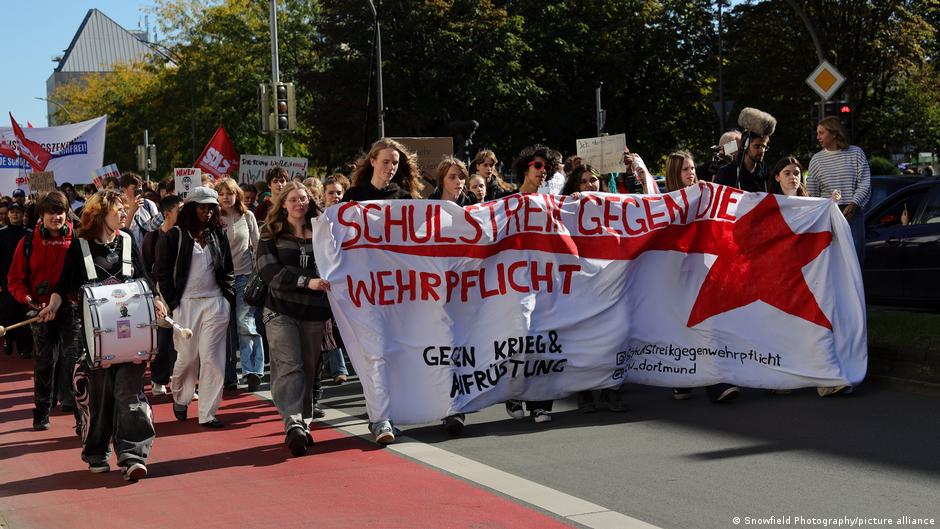
At the same time, German school students have criticized the idea of possibly bringing back military service based on necessity. In September, large protests connected to the issue took place in several German cities. For defense planners, that public reaction introduces a political risk factor around the reform’s implementation. If voluntary targets are missed and the Bundestag moves toward partial reintroduction of compulsory service, opposition could increase both administrative friction and the likelihood of further objection filings.
The current data therefore present a mixed balance sheet for Germany’s defense recruitment strategy. On the asset side, the Bundeswehr has reported its highest troop count in 13 years, stronger contract-service applications, more recruits and a higher number of suitability assessments. On the liability side, formal refusal applications have surged to more than triple last year’s full-year total within eight months, and some of those filings are generating additional procedural handling because they do not meet formal requirements.
For the Ministry of Defence, the key performance question is whether the rising recruitment pipeline can offset resistance and meet long-term force goals without triggering the need for compulsory service measures. The 2035 objective of up to 260,000 service members remains the central benchmark against which the 2026 figures will be judged.



