Slovak Protests Put Governance and Political Stability in Investor Focus
Mass demonstrations against Prime Minister Robert Fico highlight rule-of-law concerns and the coalition’s weakened parliamentary position.
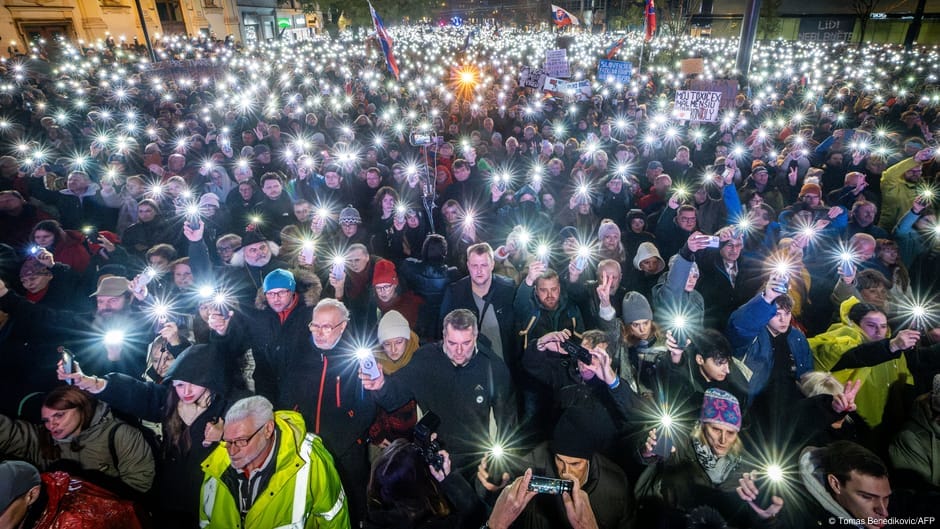
Thousands of people took to the streets across Slovakia to protest against Prime Minister Robert Fico’s government, bringing political stability, institutional governance and the durability of the ruling coalition into sharper focus for investors monitoring the country.
The demonstrations were organized to coincide with the 37th anniversary of the start of the 1989 Velvet Revolution in Czechoslovakia. Protesters criticized alleged violations of the rule of law, the government’s ties with the Kremlin, its approach to media control and its policies affecting LGBT rights.
Although the rallies did not center on corporate earnings, public finances or specific economic measures, their scale adds a political-risk dimension to the assessment of Slovakia’s operating environment. For companies, lenders and shareholders, sustained institutional tensions can affect confidence in policy continuity, regulatory oversight and the government’s ability to advance legislation.
Coalition arithmetic becomes a key risk indicator
The largest rally took place in Bratislava’s Slovak National Uprising Square. Progressive Slovakia, the country’s biggest opposition party and the organizer of the event, estimated attendance at approximately 25,000 people.
The crowd chanted, “We have had enough of Fico!” while demonstrators carried banners calling for the resignation of the three-party government led by the prime minister. Some placards read, “Russians, go home!” and “I do not want a country I will have to flee.”
“We have had enough of Fico!” protesters chanted in Bratislava as they demanded the government’s resignation.
Some demonstrators told AFP that they were dissatisfied with Slovak Foreign Minister Juraj Blanar’s recent visit to Moscow. The criticism reflects wider opposition to the Fico government’s relations with the Kremlin and adds a foreign-policy component to the domestic dispute.
From a financial-reporting perspective, the most consequential development is the ruling coalition’s loss of its absolute majority in parliament after several lawmakers departed its ranks. The change does not automatically bring down the government, but it makes parliamentary arithmetic more important when evaluating the administration’s capacity to pass policy measures and maintain a predictable legislative agenda.
The opposition has called for early parliamentary elections since the coalition lost its majority. However, it does not currently have the votes required to approve such a decision. That leaves Slovakia in a period of political uncertainty without a clear parliamentary route to an immediate election.
Governance questions enter the investment narrative
For investors and corporate finance teams, the demonstrations underscore risks that are not readily captured in an income statement or balance sheet. Rule-of-law concerns, disputes over media policy and pressure on governing institutions can influence perceptions of country risk, even when no direct financial metric is disclosed.
The protests may therefore be relevant to the qualitative sections of company reporting, including management discussions of regulatory exposure, political uncertainty and market conditions. Businesses with significant Slovak operations may also watch whether the coalition’s weakened position delays legislation or produces changes in government priorities.
No financial losses, budgetary effects, changes in sovereign borrowing costs or revisions to corporate forecasts were reported in connection with the rallies. The immediate investor significance lies instead in the size of the mobilization and the political constraints facing the government. These factors could become more material if the confrontation persists or begins to affect policymaking.
The anniversary context also gives the protests broader symbolic weight. The Velvet Revolution ended communist rule in Czechoslovakia, and the demonstrators linked that legacy to present-day concerns about democratic standards and Slovakia’s political direction.
For now, Fico’s three-party administration remains in office, while the opposition lacks sufficient support to force early elections. The resulting standoff places parliamentary cohesion, institutional credibility and relations with Moscow among the principal non-financial indicators for stakeholders assessing Slovakia’s near-term outlook.
Future developments will depend on whether the government can preserve enough legislative support to operate effectively and whether public pressure translates into shifts within parliament. Until then, the protests represent a visible governance signal rather than a measurable change in Slovakia’s reported financial performance.



