Ukraine Reports 28 Dead in Russian Strike as Sanctions Debate Turns to War Costs
Ukrainian officials said a missile and drone barrage killed 28 people, while President Volodymyr Zelensky linked the attack to sanctions pressure and Russia’s war financing.
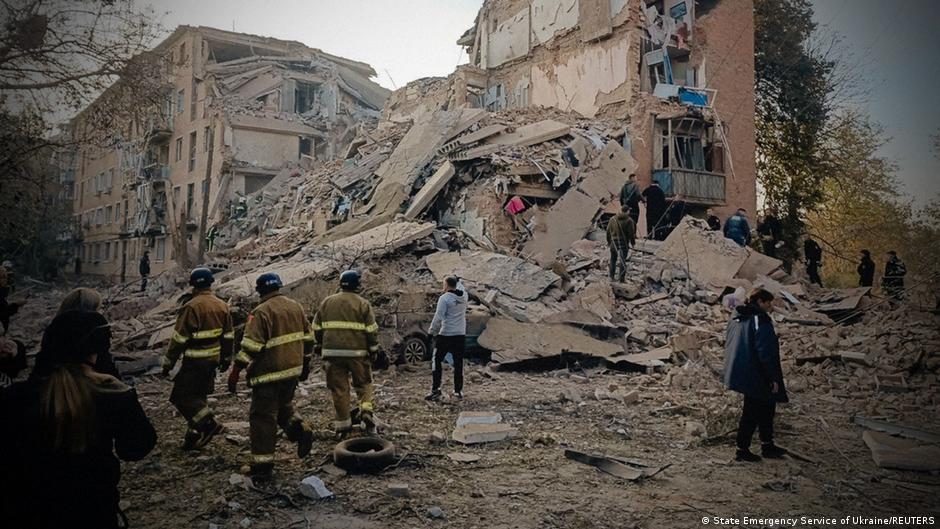
Ukraine said 28 people were killed after a mass Russian attack involving missiles and drones, a strike that immediately sharpened Kyiv’s argument that sanctions, energy revenue and the financial incentives behind the war remain central to the conflict’s trajectory.
Interior Minister Ivan Vyhovsky said on his Telegram channel on Wednesday evening, October 7, that 28 people had died in Ukraine as a result of the large-scale shelling by Russian armed forces. According to Vyhovsky, emergency workers and police officers pulled people from rubble, evacuated residents from destroyed buildings and rescued people from fire. He said 29 people had been extracted, evacuated or saved.
The hardest-hit location identified by Ukrainian officials was Pryluky, where a missile struck a residential apartment building. Vyhovsky said the removal of rubble there had continued for more than 14 hours. He later reported that 20 people were killed in Pryluky, including five children, three of whom were one year old.
President Volodymyr Zelensky said in a separate Telegram post the same evening that 100 people were wounded in the attacks. He described the strike as a combined assault using a large number of ballistic missiles, cruise missiles and Shahed drones, followed later in the day by additional attacks using Shahed drones and aerial bombs.
“The strike was combined: many ballistic missiles, many cruise missiles, Shaheds,” Zelensky said, according to the source text.
The attack took place on October 7, a date Zelensky associated with Russian President Vladimir Putin’s birthday, saying Putin had made himself a “gift” through the killing of children and civilians. The Ukrainian president also said Russian forces attacked 13 regions of Ukraine that day using 70 missiles, including many ballistic missiles, as well as Shahed drones.
Kyiv Links the Attack to Sanctions and Russian Revenue
While Ukrainian officials focused first on casualties and rescue operations, Zelensky’s comments also placed the attack inside a broader financial and diplomatic frame. He argued that the international response to Russia must not be reduced to statements of concern, but should address what he portrayed as Moscow’s continuing ability to fund and justify the war economically.
Zelensky said it was important that leaders not remain silent about what happened, and about what he said was Russia’s intention to continue moving toward escalation, killings and shelling. He argued that Putin does not feel that the war is creating problems for him.
For investors, energy markets and policy analysts, the Ukrainian president’s remarks pointed to the financial architecture surrounding the conflict: sanctions enforcement, oil revenue, restrictions on Russian elites and the market signals that Kyiv says Moscow receives from any easing of pressure. Zelensky said that through a weakening of sanctions measures against Russia and signals about lifting sanctions from oligarchs, Moscow is being sent signals about a normalization of the war against Ukraine.
He said Putin can still sell oil, and when he counts profit in dollars and euros, the war still pays off and remains profitable for him to wage. The statement underscored Kyiv’s long-running position that the cost-benefit calculation in Moscow is shaped not only by battlefield losses and military supply, but also by foreign-currency revenue, export channels and the perceived durability of Western sanctions.
Although the figures disclosed by Ukrainian officials were casualty and attack figures rather than corporate or budget data, Zelensky’s framing cast the strike as part of a larger balance-sheet question for governments: whether sanctions are imposing sufficient costs on Russia, and whether any loosening of restrictions changes the incentives behind continued escalation.
Casualties, Rescue Work and Regional Impact
Vyhovsky said emergency personnel and police continued rescue work after the strikes, including the extraction of people from rubble and evacuation from destroyed buildings. In Pryluky, the search and clearing operation after the missile strike on the apartment building continued throughout the day, according to Zelensky’s post.
Vyacheslav Chaus, the head of the Chernihiv regional military administration, had earlier reported more than 50 injured as a result of the attack. The later national figure given by Zelensky put the number of wounded from the attacks at 100.
The regional scale described by Zelensky was broad. He said Russian forces attacked 13 Ukrainian regions on October 7. The weapons mix he listed included 70 missiles, many ballistic missiles and Shahed drones. The use of multiple classes of weapons in one attack, as described by Ukrainian officials, reinforced Kyiv’s depiction of the strike as a major coordinated barrage rather than a localized incident.
The casualty figures from Pryluky were particularly severe. Vyhovsky’s account said 20 people died there, including five children. The detail that three of the children were one year old added to the political and humanitarian force of Kyiv’s response, and Zelensky characterized the attack as the killing of children and people.
Financial Pressure as a Policy Test
Zelensky said the issue is not only a problem for Ukraine and its people, but for all of Europe and the Western world. His comments effectively framed the aftermath of the strike as a test of whether Western governments treat sanctions as a strategic financial instrument or allow pressure on Russia to erode over time.
From a financial reporting perspective, the significance of the remarks lies in the direct connection Zelensky drew between oil sales, profits counted in dollars and euros, and the perceived affordability of the war for Russia. He did not provide figures for Russian oil revenue or sanction-related flows in the post cited by the source text, but his argument was explicit: as long as Moscow can generate hard-currency income and does not experience sufficient financial consequences, the war remains economically advantageous from the Kremlin’s perspective.
The attack therefore adds urgency to the sanctions debate at a time when Kyiv is warning against any signals that could be interpreted as normalization. Ukrainian officials reported 28 dead, 100 wounded, 13 regions attacked and 70 missiles used, while Zelensky’s broader message was that the financial conditions sustaining the war must remain at the center of the international response.



