Warsaw Independence March Draws 250,000 Amid Political Tensions
Poland’s president joined the nationalist-led event as rival attendance estimates and political divisions sharpened scrutiny of state governance.
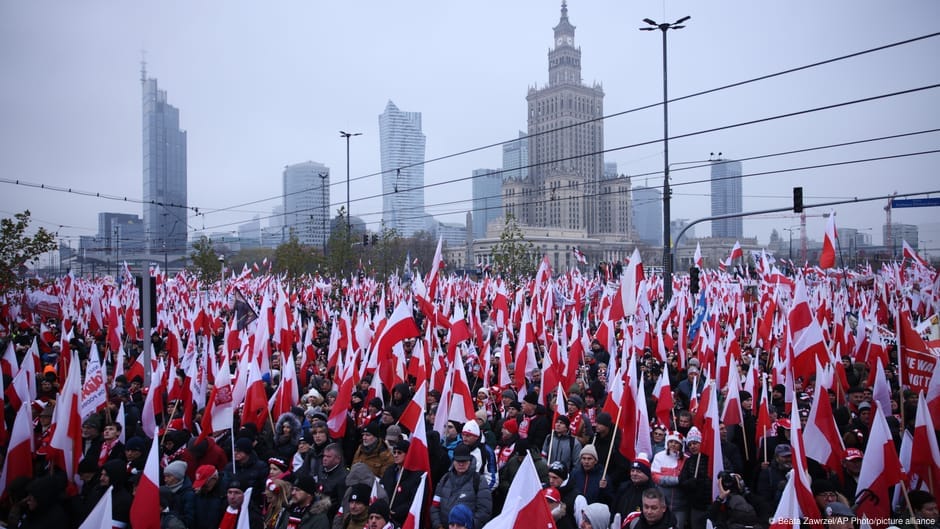
About 250,000 people attended Warsaw’s Independence March on Wednesday, November 11, according to the Polish capital’s authorities, while organizers put participation at more than half a million. The substantial gap between the two estimates highlights the difficulty of independently measuring large public gatherings and may shape political claims about the event’s scale.
Polish President Karol Nawrocki joined the march, which was organized by nationalist and far-right groups to mark the country’s National Independence Day. His participation gave the annual demonstration additional political significance at a time of confrontation between Nawrocki’s camp and the government of Prime Minister Donald Tusk.
For investors and companies monitoring Poland, the event did not produce new fiscal measures, corporate disclosures or economic targets. Its relevance lies instead in the broader governance environment: political polarization, institutional disputes and public-security pressures can influence assessments of policy predictability and the state’s capacity to implement its agenda.
Institutional conflict raises governance scrutiny
The demonstration took place only days after a shooting in central Krakow that killed six people, AFP reported. It also came as Tusk’s government and Nawrocki’s political camp were contesting control of Poland’s Constitutional Tribunal. Authorities imposed heightened security measures around the Warsaw event.
Nawrocki called for a “strong and efficient state” and criticized “elites acting against the will of the people,” according to AFP. The remarks placed state effectiveness at the center of his message, although no budget figures, spending commitments or other measurable financial policies were announced in connection with the march.
“11 November, all hearts are white and red,” Tusk said in an appeal for national unity.
The prime minister declined to participate in the demonstration. His decision underlined the political distance between the government and the president, whose institutional rivalry may remain relevant to stakeholders assessing legislative execution, regulatory stability and Poland’s decision-making framework.
National symbols and extremist material
The Polish national anthem was played before the march began. Some participants carried torches, with thick smoke surrounding parts of the procession, AFP reported. Many attendees wore red and white and waved national flags.
Near the Palace of Culture and Science, tents and stalls formed what journalists described as an “independence city.” Rosaries, prayer books, red-and-white wreaths, hot tea and sauerkraut were distributed there. The area also featured antisemitic and anti-Ukrainian books, as well as items bearing far-right extremist symbols.
AFP correspondents observed banners carrying slogans including “Make Europe white again,” which the Russian-language source rendered as “Make Poland white again” and linked to the wording of US President Donald Trump’s “Make America Great Again” slogan. Other banners read “Poland is not for sale” and “Remigration, deportation.”
The messages reinforced the march’s association with hard-right political movements and could draw attention from international businesses and investors concerned with reputational exposure, workforce policy and social stability. However, the source provided no evidence of an immediate market reaction, changes to corporate earnings expectations or revisions to Poland’s public finances.
Annual event carries added presidential weight
Right-wing extremists have organized similar demonstrations in Poland every year since 2011. Organizers present the event as a commemoration of Poland regaining independence on November 11, 1918, after 123 years of foreign rule by Russia, Prussia and Austria.
This year, Nawrocki was photographed by AFP carrying the Polish flag. His presence distinguished the march from an event attended solely by activists and supporters, connecting it more directly to the presidency and the continuing contest over Poland’s institutions.
The rival crowd estimates may also become part of that political contest. Warsaw authorities reported approximately 250,000 attendees, while organizers claimed more than 500,000. No methodology was provided for either calculation, making the figures difficult to reconcile. For financial-reporting readers accustomed to audited metrics, the discrepancy is a reminder that political attendance data generally lack the verification standards applied to company results, balance sheets or official economic statistics.
While the march generated no direct earnings, quarterly-results or balance-sheet disclosures, its scale and the president’s involvement provide a signal about Poland’s domestic political climate. The immediate focus remains on institutional control, security and the government’s ability to operate amid a deeply polarized public arena.



