Pussy Riot and Femen Stage Protest at Russian Pavilion During Venice Biennale Amid Political Controversy
Activists demand representation by pro-Ukrainian political prisoners as Russia faces backlash over its participation in Venice Biennale.
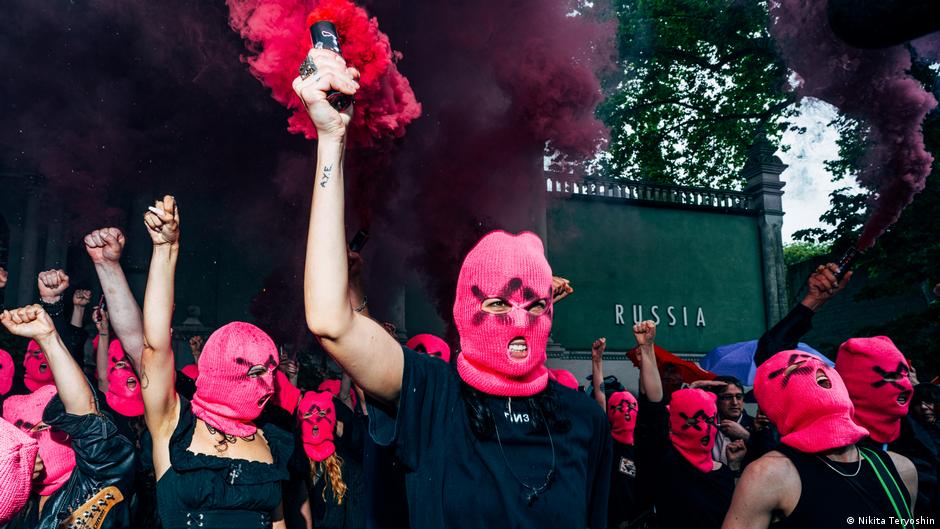
On May 6, feminist punk-rock group Pussy Riot and Ukrainian women's rights movement Femen organized a protest outside the Russian pavilion at the Venice Biennale, demanding that Russia be represented by political prisoners holding pro-Ukrainian views. This action highlights ongoing tensions surrounding Russia's participation in the prestigious international art event amid the geopolitical crisis resulting from the war in Ukraine.
Political Activism Intersects with Financial and Institutional Implications
The protest involved the burning of pink, yellow, and blue smoke bombs, slogans chanting "Russian art is blood," and display of placards reading "Enjoy the show - ignore the war," "Curated by Putin, corpses included," and "Art on display, graves below." Some protesters also inscribed these statements on their bodies, while statues at the pavilion were adorned with Ukrainian flags and masks.
"The best citizens of Russia are either imprisoned for anti-regime and pro-Ukrainian actions or killed in detention, while Europe opens its doors to Putin's officials and propagandists," said Pussy Riot member Nadezhda Tolokonnikova.
Tolokonnikova emphasized that those who suffer under political repression—namely, artists imprisoned for their anti-war and pro-Ukrainian stances—should be the true representatives of Russia at the Biennale. Similarly, Femen leader Inna Shevchenko declared, "Every Russian artwork displayed this year rests on an invisible pedestal: Ukrainian blood. You won't find this in the catalogue, but it is the only material truly supporting this pavilion."
Russia's participation at the Venice Biennale marks its first appearance since the full-scale invasion of Ukraine began, a move that has sparked intense criticism from the European Union and Ukraine. The European Commission has stated that allowing Russia's pavilion violates EU sanctions legislation. Consequently, the organizers restricted the pavilion's public access to May 6-8 for invited guests only, coinciding with a continuous sound performance titled "Tree Rooted in the Sky." The pavilion was closed to the general public starting May 9, when the Biennale officially opened.
The controversy led to the Biennale jury excluding Russia and Israel from award considerations and subsequently resigning. This unrest reflects broader challenges faced by cultural institutions balancing artistic expression with geopolitical and ethical considerations.
The Russian pavilion is managed by Smart Art, a company founded by Ekaterina Vinokurova and Anastasia Karneeva. Vinokurova is the daughter of Russian Foreign Minister Sergey Lavrov, while Karneeva is daughter of a retired general and former deputy director of the state defense conglomerate Rostec. This connection underscores the intertwining of political, military, and cultural spheres in Russia’s representation at the Biennale.
From a financial perspective, Russia’s pavilion at the Venice Biennale, a key event in the international art calendar, represents both an investment in cultural diplomacy and a potential reputational risk. The selective opening and the lack of eligibility for awards may affect the pavilion’s influence and future funding. Investor and stakeholder reactions to such controversies could impact organizations associated with Russia's cultural exports and soft power strategies.