Italy Cost-of-Living Protests Raise Fresh Risks for Retail and Public Finances
Demonstrations over prices, fuel costs and government policy prompted hundreds of detentions and tighter security across major Italian cities.
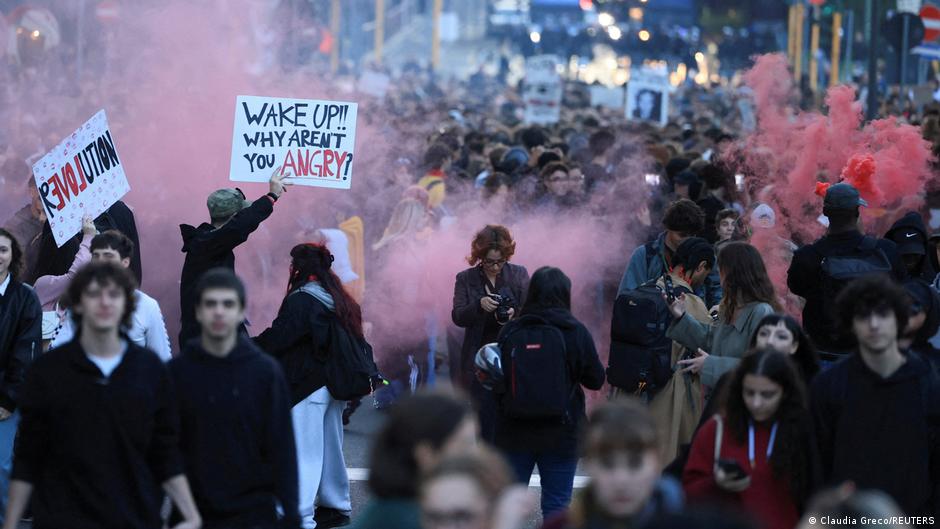
Italy faced renewed protests on Saturday, October 24, as demonstrators mobilized against the high cost of living, rising fuel prices, increased armament spending and the policies of Prime Minister Giorgia Meloni’s government. The unrest adds a financial dimension to the political pressure confronting the administration, with household purchasing power, public expenditure priorities and commercial disruption all moving into sharper focus.
Police reported nine arrests and 371 cases of preliminary detention, including 110 involving minors, according to AFP. The figures followed protests on October 17 and 18 that escalated into disorder and prompted the authorities to strengthen security measures before the latest demonstrations.
For businesses and investors, the immediate financial implications center on additional security costs, potential disruption to retail activity and transport infrastructure, and the broader effect of persistent price pressures on consumer confidence. Although no estimate of economic damage was provided, precautions taken by luxury retailers in Milan illustrated how civil unrest can affect commercial operations even when demonstrations remain largely peaceful.
Security deployment adds to the public-cost equation
Italian authorities deployed 500 troops from elite units to Milan following the earlier unrest. The government also simplified procedures for detaining minors and for imposing financial penalties on their parents when property is damaged.
Drones and helicopters were used to monitor the demonstrations, while patrols at railway stations were reinforced. Authorities also closely tracked online activity to identify new calls for disorder. Together, the measures point to a widening security response that involves personnel, surveillance and transportation-hub protection, although officials did not disclose the cost of the operation or its budgetary impact.
The protests have brought household affordability concerns into direct contact with the government’s spending priorities and the operating risks faced by businesses in major cities.
The demonstrators’ objections to higher fuel prices and increased armament spending reflect two distinct financial pressures. Fuel costs directly affect household budgets and can feed into transportation and distribution expenses, while military expenditure raises questions about the allocation of public funds. The source material did not provide inflation figures, fiscal estimates or details of planned defense spending, but the demonstrations indicate that these issues have become politically linked in the public debate.
Luxury retailers protect storefronts in Milan
In Milan, the protests were mostly peaceful until the evening, according to the dpa news agency. Demonstrators later clashed with law enforcement officers in the city center, where police stopped a procession and used batons.
Fearing further unrest, the owners of many luxury stores barricaded their display windows. The precaution is particularly relevant from a financial-reporting perspective because physical security measures, temporary access restrictions and weaker customer traffic can create short-term costs for retailers. The article provided no figures for lost sales, property damage or insurance exposure, and it did not identify individual companies affected.
Even without quantified losses, the response by store owners underscores the sensitivity of high-value shopping districts to public-order risks. Investors assessing consumer-facing companies typically monitor not only revenue and margins but also disruptions that may affect store hours, inventory protection and footfall. The protests occurred as dissatisfaction over living costs was already placing household expenditure under pressure.
Transport hubs become focal points
In Bologna, police used tear gas and water cannon to prevent a column of demonstrators from approaching the railway station. In Turin, law enforcement officers pushed protesters back with shields. Reinforced protection around transport infrastructure suggests that the authorities viewed railway access as a significant operational concern.
Disruption at major stations can have consequences for passenger movement, commerce and logistics, though the source did not report service suspensions or financial losses. The preventive measures therefore represent risk containment rather than evidence of a measured economic impact.
In Rome, a predominantly pro-Palestinian demonstration moved through the historic center. At one point, participants entered the Colosseum, dpa reported. Protests were also held in Naples and Florence, demonstrating that the mobilization extended across several of Italy’s largest urban economies rather than remaining concentrated in one city.
The protests leave the Meloni government facing pressure on several financially sensitive fronts: household living costs, fuel prices, defense spending and the expense of maintaining public order. For companies, particularly retailers and businesses dependent on city-center traffic or transport networks, the key issue will be whether demonstrations continue and begin to produce measurable effects on sales, operating expenses or asset protection. No corporate earnings revisions, balance-sheet impacts or official damage totals were reported in connection with Saturday’s events.