Sanctioned Tanker MYRA Issues Distress Signal in North Atlantic
The incident highlights the financial and operational risks surrounding sanctioned networks used to transport Russian and Iranian oil.
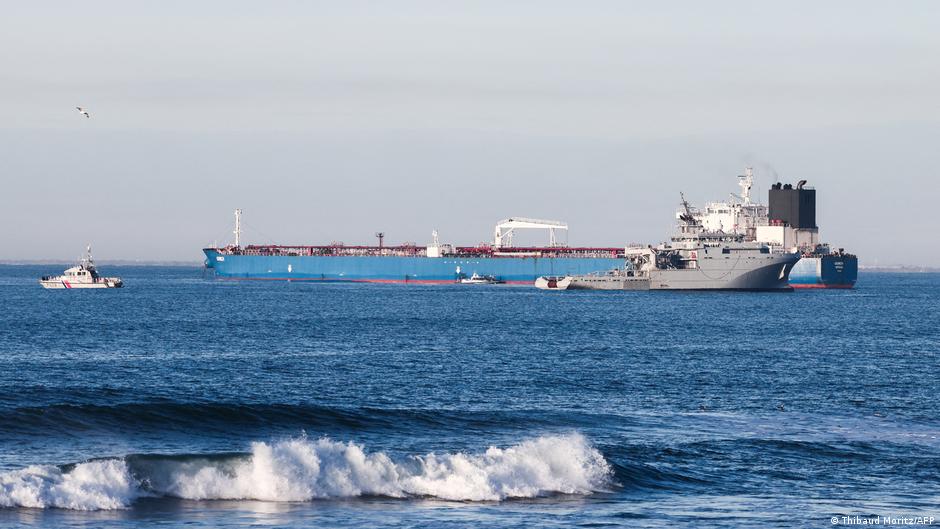
The sanctioned oil tanker MYRA has issued a distress signal in the North Atlantic off Ireland’s northwestern coast, drawing renewed attention to the financial, operational and compliance risks associated with vessels accused of carrying Russian oil outside established Western trading channels.
SeaNews, a maritime monitoring project, reported on Saturday, Oct. 24, that the distress signal was transmitted through the Inmarsat-C satellite communications system. The UK Coastguard is coordinating the operation involving the tanker, which is under sanctions imposed by the United States, the European Union and the United Kingdom.
According to SeaNews, the 75,000-ton vessel had departed from the Russian port of Ust-Luga and continued moving at about 9 knots, or roughly 17 kilometers per hour, despite extreme weather. Waves in the area reportedly reached 8.8 meters when the signal was sent, while wind gusts were estimated at approximately 130 kilometers per hour. The tanker was about 348 kilometers from the coast.
Sanctions Increase Financial Exposure
The maritime emergency underscores the balance-sheet risks surrounding aging or opaque tanker networks operating under multiple sanctions regimes. A casualty involving a designated vessel can create uncertainty over insurance coverage, access to emergency services, repair financing and responsibility for environmental liabilities. Such risks may extend beyond a ship’s registered owner to operators, charterers, cargo interests, lenders and counterparties involved in a voyage.
No financial losses, cargo damage or pollution were reported in the source account, and the vessel remained underway. The available information also did not identify the value or volume of any cargo aboard MYRA, its ultimate destination, its insurer or the entities financing the shipment.
Those missing details are material from an investor and creditor perspective. Tanker incidents can result in repair costs, off-hire periods and delays in recognizing freight revenue. Severe damage or a spill could also generate substantial claims and impair the value of the vessel or cargo. Sanctions may complicate any settlement by restricting payments, banking services or commercial dealings with listed assets and entities.
The vessel reportedly remained in motion at about 9 knots despite waves reaching 8.8 meters and wind gusts of around 130 kilometers per hour.
Ukraine’s military intelligence agency, the GUR, lists MYRA in its War & Sanctions database and says the tanker has been used to export Russian oil and petroleum products to third countries while circumventing sanctions. The agency links the vessel to Fractal Marine DMCC, a company registered in the United Arab Emirates that it describes as one of the leading operators of Russia’s so-called shadow fleet.
According to the GUR, MYRA has repeatedly called at the Russian ports of Ust-Luga and Primorsk. It has also visited ports in Senegal, Turkey, Brazil, Estonia and Denmark. The vessel’s reported trading pattern illustrates the international reach of shipping structures that Western governments say help preserve revenue flows from sanctioned energy exports.
Multiple Jurisdictions Have Listed the Vessel
The War & Sanctions database says the United States added MYRA to its sanctions list on July 30, 2025. The European Union followed on Oct. 24, 2025, while Switzerland and Ukraine listed the ship on Dec. 13, 2025. The United Kingdom imposed sanctions on Feb. 24, 2026, and Canada did so on March 25, 2026.
The accumulation of restrictions across major financial jurisdictions can narrow a vessel’s access to conventional maritime services. Banks, insurers, commodity traders and port providers generally face heightened due-diligence requirements when dealing with sanctioned ships or potentially connected companies. That can raise transaction costs, increase dependence on intermediaries and make ownership, revenue and liability harder for investors and regulators to assess.
Ukraine’s intelligence service further alleges that MYRA belongs to a shipping network controlled by Mohammad Hossein Shamkhani. He is the son of Ali Shamkhani, the former secretary of Iran’s Supreme National Security Council and a former adviser to the country’s supreme leader. Ali Shamkhani was killed in a joint US-Israeli operation in February 2026, according to the source article.
The GUR claims that the younger Shamkhani controls a network of tankers, operators and shell companies used for money laundering and the transportation of Russian and Iranian oil, including shipments to China. These are allegations by Ukrainian intelligence; the source account did not provide responses from Shamkhani, Fractal Marine DMCC or the vessel’s registered owner.
For companies with exposure to maritime transport or energy trading, the MYRA incident highlights the challenge of identifying ultimate ownership and quantifying contingent liabilities in sanctioned shipping networks. Until the tanker’s condition, cargo status and contractual arrangements are clarified, the direct financial impact of the distress call cannot be reliably estimated.