Putin Signals US-Mediated Ukraine Talks but Rejects Front-Line Freeze
The conflicting signals leave investors without a clear basis for assessing sanctions, reconstruction costs or regional risk.
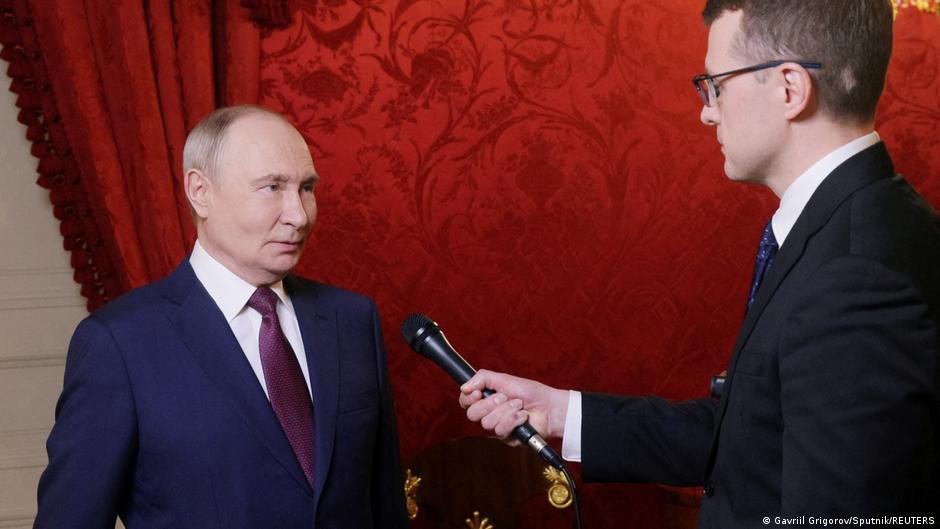
Russian President Vladimir Putin said Moscow was prepared to resume negotiations with Kyiv through US mediation, but rejected the idea of freezing hostilities along the current front line, leaving businesses and investors with no clear indication that the economic disruption caused by the war is nearing an end.
In an interview with Pavel Zarubin, a journalist for Russia’s state-owned broadcaster VGTRK, published on Thursday, October 22, Putin said he had agreed during a meeting with US special envoy Steven Witkoff to renew dialogue with Ukraine under Washington’s mediation. He described the intended talks as a route toward final peace arrangements rather than a temporary ceasefire.
“The purpose of these negotiations will be to discuss ensuring the security of Ukraine and Russia after peace agreements are reached, in their final form, rather than as a result of suspending hostilities for some short period,” Putin said. “We are ready to resume these contacts to achieve this goal.”
Moscow did not say after Putin’s meeting with Witkoff what level of representation it would send to negotiations with Kyiv. Ukrainian President Volodymyr Zelensky has said he is prepared to attend a three-way meeting with Putin and US President Donald Trump to discuss ending the war.
The Kremlin has repeatedly rejected that format or attached conditions that Kyiv did not regard as a serious basis for a meeting, including a proposal that Zelensky travel to Moscow. Earlier talks between a delegation selected by Putin and Ukrainian representatives produced no tangible progress toward ending the conflict.
Further uncertainty emerged only hours after the Putin-Witkoff meeting, when Kremlin foreign policy adviser Yuri Ushakov said Russia was “completely dissatisfied” with proposals brought to Moscow by Trump’s negotiators. The contrasting statements underscore the gap between a declared willingness to talk and agreement on the terms or format of negotiations.
Ceasefire dispute limits visibility for investors
For financial markets and corporate reporting, the absence of an agreed ceasefire framework preserves uncertainty around sanctions exposure, energy and commodity flows, logistics, insurance costs and the timing of any Ukrainian reconstruction program. The interview supplied no timetable for negotiations, financial commitments or measurable milestones that companies could incorporate into forecasts or impairment assessments.
Putin also dismissed Zelensky’s statement that Ukraine was ready to freeze fighting along the current line of contact. Asked about the proposal, the Russian president replied: “It is not their territory; it is the territory of historical Russia.”
Media reports previously said Trump had supported the concept of freezing hostilities along the front line running through the Donbas in 2025, before meeting Putin in Anchorage. Such an outcome would conflict with the Russian leader’s publicly stated demand that Ukraine surrender the whole of the Donbas to Russia without a fight.
That territorial disagreement is financially consequential because it prevents a reliable assessment of postwar borders, control of infrastructure and the jurisdiction under which assets and liabilities may ultimately sit. It also complicates long-term planning by banks, insurers, exporters and companies assessing whether regional operations can resume. No balance-sheet figures, reconstruction estimates or projected sanctions changes were disclosed in the interview.
Military attacks continue despite diplomatic language
Putin maintained that Russia “does not want to fight” Ukraine and shifted responsibility for the continuation of hostilities to Kyiv, even as Russian forces continued attacks on Ukraine.
“We are still ready to reach agreements and look for ways out of this difficult situation,” Putin said. “These are people very close to us. The latest genetic studies show that Russians and Ukrainians are one people.”
He did not explain how claims about genetics could affect questions of national sovereignty. Russia launched the war against Ukraine, and its forces have continued to conduct strikes while the Kremlin presents itself as open to negotiations.
The intensity of Russian attacks did not decline after Putin’s meeting with Witkoff. On the day Zarubin’s interview was published, Ukrainian authorities reported several Russian attacks on civilian targets. The reported sites included a clothing market in Lozova in the Kharkiv region, Kyiv’s historic center, and roads and bridges in different parts of Ukraine.
Two people were killed and 34 were wounded in Lozova as a result of a Russian strike, according to the Ukrainian side. The continued damage highlights the gap between diplomatic statements and conditions on the ground, where infrastructure destruction and civilian casualties continue to add to Ukraine’s economic losses.
From an investor-relations perspective, Putin’s remarks offer evidence that diplomatic contacts may resume but do not establish a negotiated pathway capable of changing financial assumptions. Without agreement on representation, territorial questions, a ceasefire mechanism or final security guarantees, companies remain unable to assign a dependable timeline to sanctions relief, lower regional risk premiums or reconstruction-related investment.
The immediate signal is therefore mixed: Moscow says it is ready for US-mediated contacts, while rejecting a front-line freeze and criticizing proposals delivered by American negotiators. Until those positions converge and military activity declines, the war is likely to remain a major source of uncertainty for corporate earnings, asset valuations and balance-sheet risk across the region.