Serbia Election Raises Governance Risks as Opposition Rally Draws 150,000
A closely contested parliamentary vote could reshape political oversight and increase investor scrutiny of governance in Serbia.
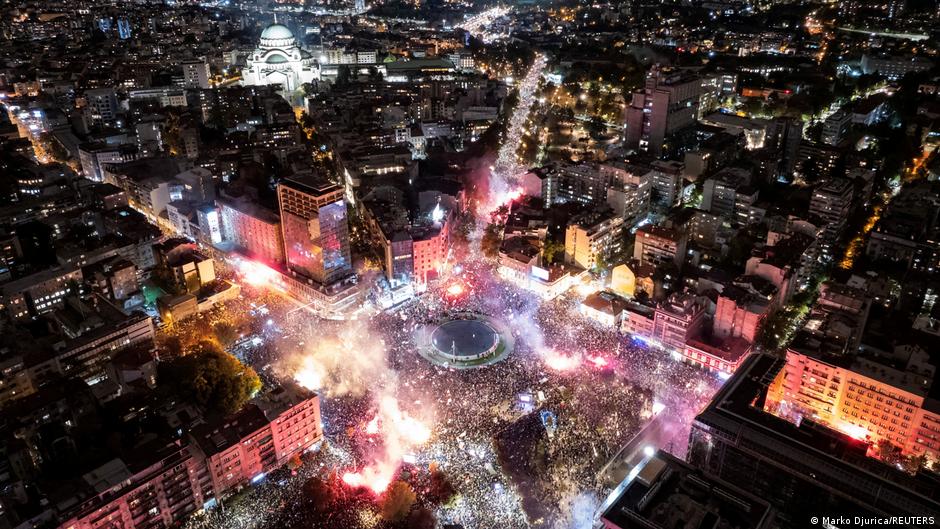
Serbia is approaching an early parliamentary election with heightened political uncertainty after opposition supporters staged a mass demonstration in Belgrade and polling indicated that President Aleksandar Vučić’s party could lose ground.
Organizers said about 150,000 people attended the rally in the Serbian capital on Thursday, October 22, according to AFP. Demonstrators called for an end to Vučić’s rule and urged voters to support the Student List, a movement that emerged from a wave of student protests and has since become a significant political force.
For investors and companies monitoring Serbia, the October 25 election represents a test of political continuity, public-sector accountability and institutional governance. The campaign has centered on allegations of corruption surrounding a fatal infrastructure failure, putting government oversight and the management of public projects under particularly close scrutiny.
Infrastructure tragedy drives governance debate
The early election follows almost two years of protests triggered by the November 2024 collapse of a canopy at the Novi Sad railway station. Sixteen people were killed. The station had undergone renovation shortly before the disaster, and Serbia’s independent media and opposition groups identified corruption as one of the principal causes of the tragedy.
The collapse turned questions about procurement, project supervision and political responsibility into a nationwide protest movement. Students became its main driving force, eventually creating the Student List as an electoral vehicle.
The election has developed into a referendum on political continuity, institutional accountability and confidence in the oversight of public projects.
The Student List has adopted an unconventional organizational model. It has no clear leader and will not field professional politicians as candidates. Instead, students want academics, activists and public figures to represent the movement. Most Serbian opposition parties have withdrawn from the race and called on their supporters to vote for the student-backed slate.
That structure may appeal to voters seeking an alternative to established parties, although the absence of a traditional leadership hierarchy also leaves questions about how the movement would organize decision-making if it entered government. From a financial-reporting perspective, any change in governing personnel would place attention on the continuity of budget administration, public investment oversight and communications with businesses and investors.
Polls signal a narrow and potentially consequential contest
A survey by the New Serbian Political Thought project, published on October 20, showed the Student List ahead of the Serbian Progressive Party, or SNS, led by Vučić. The student movement received support from 44.5% of respondents, compared with 42.7% for the SNS.
An equivalent poll in early October showed the Student List at 44.4% and the governing party at 41.7%. The figures suggest that support for the students remained broadly stable while backing for the SNS increased by one percentage point. Even so, the October 20 results placed the two competitors only 1.8 percentage points apart, underscoring the closeness of the race.
The outcome will determine whether Serbia experiences a transfer of parliamentary power or maintains the political structure that has dominated the country for more than a decade. A narrow result could also increase scrutiny of official communications and the incoming administration’s ability to present a clear policy agenda.
Vučić seeks return to prime minister’s office
Vučić has served as Serbia’s head of state since 2014, according to the source account, and demonstrators have repeatedly demanded his resignation. Although he has said several times that he would take that step, he is effectively seeking to change offices rather than leave power. On October 25, he will compete for the position of prime minister.
A victory for the Serbian Progressive Party would therefore keep Vučić in power. Under Serbia’s constitution, the prime minister has broader authority than the president, although Vučić became the most recognizable figure within the governing establishment during his presidency.
He previously served as prime minister from 2014 to 2017 and left that post after winning the presidential election. Representatives of his party have continuously held the prime minister’s office since then.
For financial stakeholders, the central issue is not a disclosed change in specific fiscal targets or corporate regulation; the source provides no such policy commitments. Instead, the immediate focus is political control, governance credibility and the handling of public investment after the Novi Sad disaster. The election result will show whether voters favor continuity under the SNS or a student-led challenge built around demands for accountability.