Uzbekistan’s First ID Card Fee Draws Scrutiny as Regional Cost Gap Widens
A debate over first-time ID card charges is focusing attention on Uzbekistan’s fee formula, planned 2026 indexation and cheaper regional alternatives.
A debate over the price of a first national ID card in Uzbekistan has moved from social media into a broader discussion about public charges, household affordability and how administrative fees are structured. The issue gained traction after journalist Dilnoza Qurbonova described seeing a 15- or 16-year-old girl and her parents at a passport office, where they had come to obtain the girl’s first identity document. Qurbonova said the parents’ worn clothing and expressions reflected the strain of hard work and daily financial worries.
“He opened his wallet and started counting even the last small coins one by one,” Qurbonova wrote, adding that the father’s distress and the girl’s downcast look made her heart ache.
That account has sharpened a policy question with clear financial dimensions: how fair is the state duty charged for a citizen’s first identity document, and how does Uzbekistan’s pricing compare with neighboring countries and other regional systems? The comparisons cited in the source material show multiple lower-cost models across the region, and in some cases a full waiver for first-time applicants.
Fee Formula Tied to the Base Calculation Unit
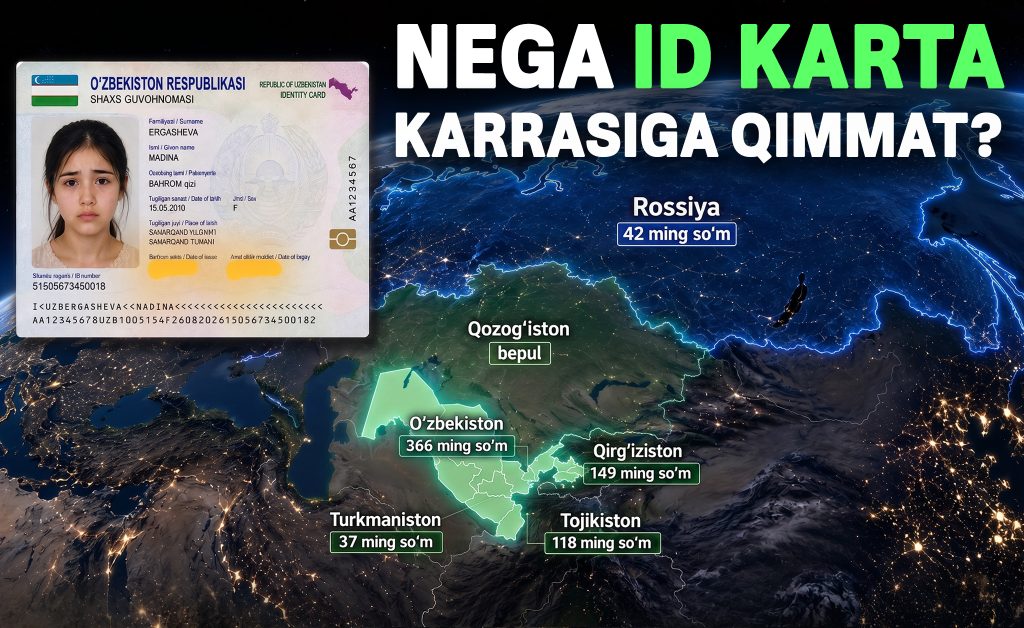
In Uzbekistan, the state duty for a first ID card depends on how the application is filed. When citizens apply through a migration department, a public services center or a consulate, the charge is set at 89% of the base calculation unit, or BHM. With the BHM currently at 412,000 soums, that puts the fee at 366,680 soums.
Applicants who file online through my.gov.uz pay a slightly lower rate, set at 80.1% of the BHM. At current levels, that means 330,012 soums for a first ID card processed online. The structure effectively links the cost of the document to an indexed administrative benchmark rather than a fixed nominal price, making the fee sensitive to future changes in the BHM.
The BHM has been set at 412,000 soums since August 1, 2025. From September 1, 2026, it will rise to 440,000 soums. If the ID card rates remain unchanged, the state duty for applications filed through a migration department, public services center or consulate would increase to 391,600 soums, while the online fee through my.gov.uz would reach 352,440 soums. For lower-income households, the debate is therefore not only about the current tariff, but also about a built-in path to higher charges if the benchmark rises again.
Regional Comparison Shows Cheaper First-Issue Models
Kazakhstan has moved in the opposite direction. From January 1, 2026, every citizen turning 16 can obtain an ID card for the first time free of charge, and renew it at the end of its validity period without paying a state duty. The waiver also applies in cases where a citizen receives the document for the first time after age 18, acquires Kazakh citizenship, or falls under certain other categories. The initiative is aimed at reducing citizens’ financial burden and simplifying document processing.
In Kyrgyzstan, citizens obtaining an ID card for the first time can process the document under the standard procedure within 12 working days for 1,103 Kyrgyz soms. At the exchange rate cited in the source material, that is about $12.6 or 149,000 Uzbek soums. On that basis, a first ID card under Kyrgyzstan’s standard procedure is about 2.5 times cheaper than Uzbekistan’s current 366,680-soum state duty.
Tajikistan also posts a lower nominal entry cost. The fee for issuing a citizen’s ID card is set at $10, with the amount collected in the national currency, somoni, at the exchange rate on the day of payment. Processing time is set at up to 15 days. According to the official exchange rate of the Central Bank of Uzbekistan on August 21, $10 is roughly equal to 118,000 Uzbek soums, making the charge about 3.1 times cheaper than the amount currently collected in Uzbekistan.
Turkmenistan does not have a separate national ID card. Instead, the main identity document is a biometric passport. According to the State Migration Service, the state duty for issuing that passport is 60 manat. At the black-market exchange rate cited in the source material, that is about $3.2 or 37,000 Uzbek soums. Children under 16 are exempt from the charge. By that comparison, the cost is almost 10 times lower than Uzbekistan’s current fee.
Russia issues an internal passport once citizens reach age 14. The state duty for a first-time passport is set at 300 rubles, which is about $3.6 or 42,000 Uzbek soums at the exchange rate cited in the source material. That makes a first passport in Russia about 8.7 times cheaper than the amount charged for an ID card in Uzbekistan. Under Russia’s Tax Code, the 300-ruble state duty applies both to first issuance and to replacement under established procedure, while a lost or damaged passport carries a fee of 1,500 rubles.
Turkey’s main identity document is the Türkiye Cumhuriyeti Kimlik Kartı. In 2026, its official price is 220 Turkish lira, or about $5 and 59,000 Uzbek soums. However, if a child’s birth is registered within the legal deadline and the first identity card is issued on that basis, no fee is charged. Identity cards issued after the deadline or issued as replacements cost 220 lira.
Azerbaijan issues identity cards to citizens from age 15. According to the Interior Ministry, the state duty for standard processing of an ID card within 10 days is 5 manat. Even without a full exchange-rate comparison in the source material, the regional overview reinforces the same point: Uzbekistan’s first-issue fee stands out because it is tied to a benchmark that is already scheduled to rise.
The controversy has therefore become a question of public-finance design as much as social policy. For critics, the immediate burden on lower-income families is visible at the cashier’s desk. For policymakers, the key issue is whether a first identity document should remain a revenue-linked administrative service or be treated as a foundational civic document with a lighter fee, or no fee at all, as seen in some neighboring systems.