German Protests Against Far Right Signal Rising Political Risk for Investors
Mass demonstrations across more than 35 German cities highlighted investor-relevant uncertainty around the AfD, legal scrutiny and coalition stability.
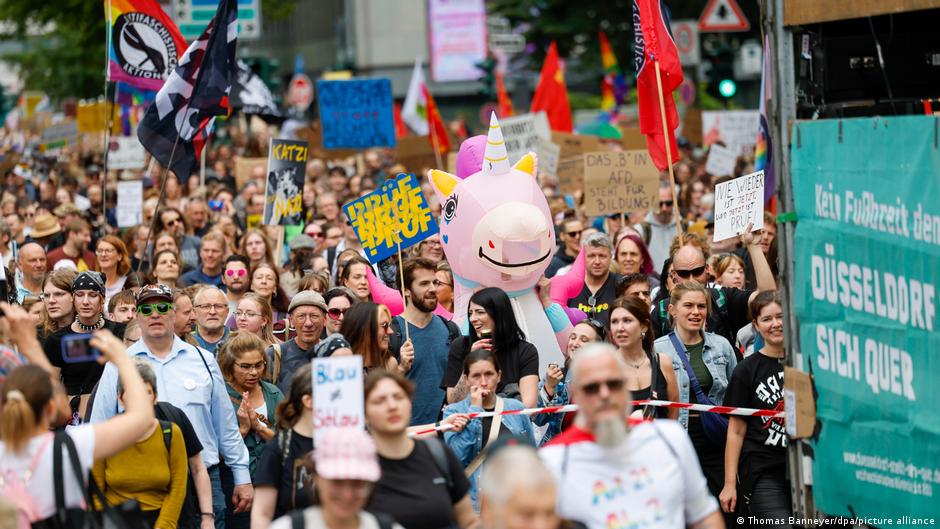
Mass demonstrations against right-wing extremism took place in more than 35 cities across Germany on Saturday, September 12, adding a significant political-risk marker for investors, corporate boards and financial-market analysts tracking Europe’s largest economy. The protests came one week after the far-right Alternative for Germany, or AfD, won state elections in Saxony-Anhalt, sharpening attention on the party’s legal status, public support and potential impact on Germany’s policy environment.
Organizers estimated that 25,000 people joined the demonstration in Hamburg, while around 20,000 took part in Düsseldorf and 18,000 in Berlin, according to police estimates in the capital. The scale of the protests matters beyond domestic politics: Germany remains a core market for European capital allocation, and political instability can affect assumptions used in investor relations, risk disclosures, regulatory planning and long-term earnings forecasts.
The demonstrations were organized by more than 100 associations and drew tens of thousands of participants nationwide. In Munich, public broadcaster ARD estimated turnout at 12,000. In Düsseldorf, organizers put participation at roughly 20,000, a figure also confirmed by local police. Around 2,000 people gathered in Mainz.
Smaller demonstrations were also recorded in regional capitals and politically sensitive areas. In Magdeburg, the capital of Saxony-Anhalt, about 1,100 people took part. Saarbrücken saw 1,500 participants. Several hundred attended in Erfurt, while several dozen joined in Schwerin, the capital of Mecklenburg-Western Pomerania, where the AfD was also leading in polling one week before local elections.
Political Risk Enters the Financial Reporting Lens
For companies reporting quarterly results or preparing annual disclosures, the protests underline a broader governance question: how to account for political fragmentation in Germany. Investors typically assess German exposure through revenue, labor costs, energy pricing, tax policy, regulation and supply-chain stability. A stronger AfD presence, or a legal process aimed at banning the party, could become part of the political-risk backdrop that management teams are asked to address in earnings calls and investor briefings.
The AfD’s recent electoral success in Saxony-Anhalt has intensified debate over whether Germany’s current political “firewall” against cooperation with the party remains viable. That question can influence coalition formation, legislative predictability and the pace of economic policy. For listed companies, banks and institutional investors, any erosion of policy clarity may feed into scenario planning around public spending, migration policy, labor availability, industrial subsidies and regulation.
Several demonstrations, including those in Munich, Mainz, Saarbrücken and Magdeburg, were held as part of the Prüf campaign. The campaign calls for a thorough review of the activities of parties classified by Germany’s Federal Office for the Protection of the Constitution, known as the BfV, as “suspected” of right-wing extremism or as “definitely right-wing extremist.” The name Prüf translates as “check,” and organizers present it as an abbreviation of the German phrase Prüfung Rettet Übrigens Freiheit, meaning “Review, by the way, saves freedom.”
Organizers presented the Prüf campaign as a call for legal and institutional scrutiny of parties classified in relation to right-wing extremism.
At the rallies, demonstrators called for the launch of a procedure to ban the AfD. In May 2025, the BfV classified the party as right-wing extremist at the federal level. However, that classification is not currently in force because of a lawsuit filed by the party. This unresolved legal status is an important distinction for financial readers: it means political and legal uncertainty remains active rather than settled.
In Düsseldorf, the demonstration was held under the slogan “Not one step back! Against the AfD and right-wing agitation” (“Kein Schritt zurück! Gegen die AfD und rechte Hetze!”). In Hamburg, the slogan was “Time to act — freedom must be defended” (“Zeit zum Handeln — Freiheit muss verteidigt werden”). While these are political slogans, they also point to the intensity of public pressure around Germany’s democratic institutions, a factor that can shape the operating climate for companies and investors.
Polling Shows a Divided Public
The latest polling cited in the source article shows a divided electorate on both a possible AfD ban and the broader firewall policy. A survey by the INSA opinion research institute, conducted on September 10 and 11, found that 42% of respondents supported the idea of banning the AfD, while 45% opposed it. The result indicates that any ban procedure would unfold in a highly contested public environment.
The same poll found that nearly half of Germans, 46%, opposed the firewall policy toward the AfD, which is based on refusing cooperation with the party. Support for maintaining the barrier stood at 34%, while 20% were unable to answer. For financial-market participants, these figures point to a complicated political landscape in which electoral arithmetic, coalition strategy and legal institutions may all affect Germany’s medium-term policy direction.
That uncertainty is relevant for investor relations teams preparing commentary on Germany-specific exposure. It may not translate immediately into balance-sheet impairments or quarterly earnings revisions, but it can influence discount rates, country-risk assessments, capital expenditure timing and stakeholder communications. Companies with large German operations may face more questions on labor relations, regional political dynamics, procurement stability and reputational risk.
The demonstrations therefore represent more than a single weekend of public protest. They reflect a broader confrontation over Germany’s institutional response to right-wing extremism after the AfD’s electoral gains. For financial reporting, the key takeaway is that political risk in Germany is becoming more visible, more measurable through polling and turnout data, and more likely to feature in investor analysis as companies assess the outlook for Europe’s largest economy.