Khodorkovsky Urges Europe to Offer Russian Elites a Path Away From Putin
The opposition figure said Europe should provide influential Russians with alternatives that could divide the Kremlin-aligned elite.
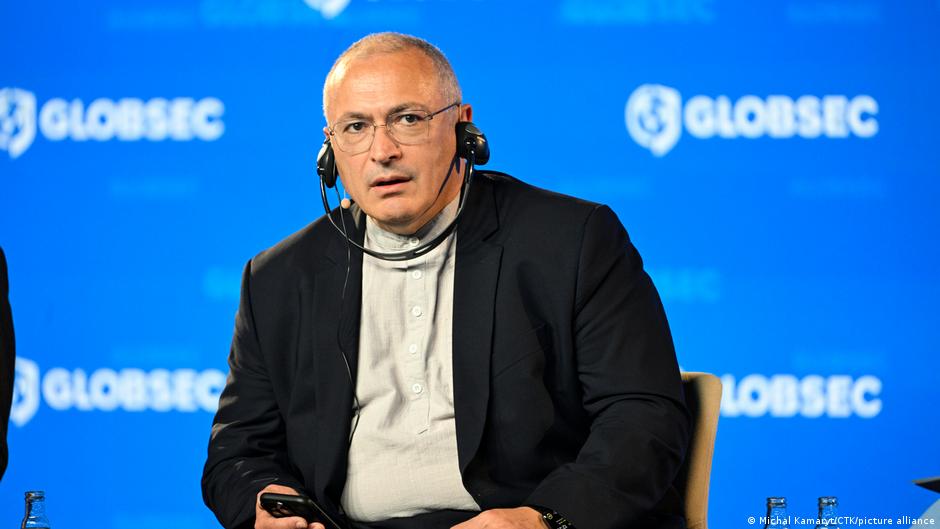
European countries should offer influential members of Russia’s elite a credible alternative to continued support for President Vladimir Putin, according to public figure Mikhail Khodorkovsky, who argued that such an approach could encourage divisions within the Kremlin’s political and economic establishment.
Speaking at a conference organized by the Russian Anti-War Committee in Brussels on Tuesday, Nov. 3, Khodorkovsky said powerful Russians remain aligned with Putin partly because they are not convinced that their circumstances would improve under a different political order. His remarks point to the role of personal financial exposure, institutional protection and expectations about future status in determining whether members of Russia’s elite remain loyal to the current system.
Asked whether domestic actors could remove Putin from power, Khodorkovsky cited the personal security system constructed by the Russian president. He also said influential people continue to support Putin because they see no sufficiently clear alternative.
“If we are talking about a split among the elites, then opportunities for an individual exit must be demonstrated,” Khodorkovsky said.
Such an exit could still entail certain losses for those involved, he added. Khodorkovsky described Europe’s failure to create those opportunities by the fifth year of the war as a serious mistake.
Exit Terms and Financial Incentives
Khodorkovsky did not specify at the conference what conditions an individual pathway away from the Russian leadership should include. He has previously written that a declaration of disagreement alone would not be sufficient for people who cooperated with the regime. As examples of more substantive action, he cited donations to Ukraine and testimony to investigators examining crimes committed by the regime.
From a financial-reporting perspective, the proposal raises questions about how Europe might distinguish between political disengagement and attempts to protect wealth or status. Any framework would potentially have implications for sanctions policy, asset restrictions and the treatment of individuals whose business interests have been closely connected to the Russian state. Khodorkovsky, however, did not set out specific financial thresholds, sanctions relief mechanisms or disclosure requirements.
His broader argument was that elite behavior depends on the perceived balance of risk. If remaining within Putin’s system appears safer than leaving it, influential figures have little incentive to defect. A defined exit route, even one involving losses, could alter that calculation and create divisions around the Russian president.
Transition Risks for Russia’s Economy and Institutions
In his opening remarks about a future political transition in Russia, Khodorkovsky also warned that efforts to prosecute people connected to the war or restrict their rights could provoke armed resistance inside the country. He said millions of Russians have links to the war because they or their relatives fought, worked at military enterprises or supported the order established by the authorities.
Some of those people are accustomed to handling weapons and could be prepared to resist measures directed against them, he said. “And we must understand that when we talk about lustration, contributions and trials of war criminals, we are talking about a new war,” Khodorkovsky said.
That warning has a financial dimension because internal conflict would threaten business continuity, government finances, industrial production and the stability of institutions overseeing property and contracts. The Russian economy’s extensive wartime connections, as described by Khodorkovsky, also suggest that any political transition would involve people employed by or otherwise linked to military production, rather than only a narrow group of senior officials.
Khodorkovsky contrasted attempts to impose political change by force with national reconciliation and gradual democratization. In his assessment, armed confrontation within Russia would produce another authoritarian system and postpone the prospect of democratic change for another political generation.
He issued a similar warning about the possible breakup of the Russian Federation, saying such an outcome would be paid for in blood. He urged opponents of the current government to discuss not only their desired result but also the methods used to achieve it.
Institutional De-escalation
As an alternative, Khodorkovsky proposed focusing on what he called “institutional de-escalation,” meaning a reduction in the threat of war through changes to the structure of power in Russia.
He said that even a transition from one-person rule to collective leadership could reduce the likelihood of war. A parliamentary model and greater federalization would lower that probability further, in his view.
For investors and companies assessing long-term Russian exposure, the institutional structure described by Khodorkovsky would be relevant to political-risk analysis. Collective decision-making, parliamentary government and federalization could change how fiscal priorities, state assets and regional interests are managed. Khodorkovsky did not present detailed economic projections or a timetable for such reforms.
The Russian Anti-War Committee’s two-day conference is taking place in Brussels on Nov. 3-4 and is focused on scenarios for ending Russia’s war against Ukraine. Its program also includes discussions of sanctions, nuclear risks and the possibility of putting Putin on trial.