Saudi Air Defenses Intercept Houthi Missile as Aramco Supply Risks Grow
The attempted strike on Riyadh adds pressure on Saudi oil infrastructure, export routes and investor scrutiny of Aramco’s near-term operations.
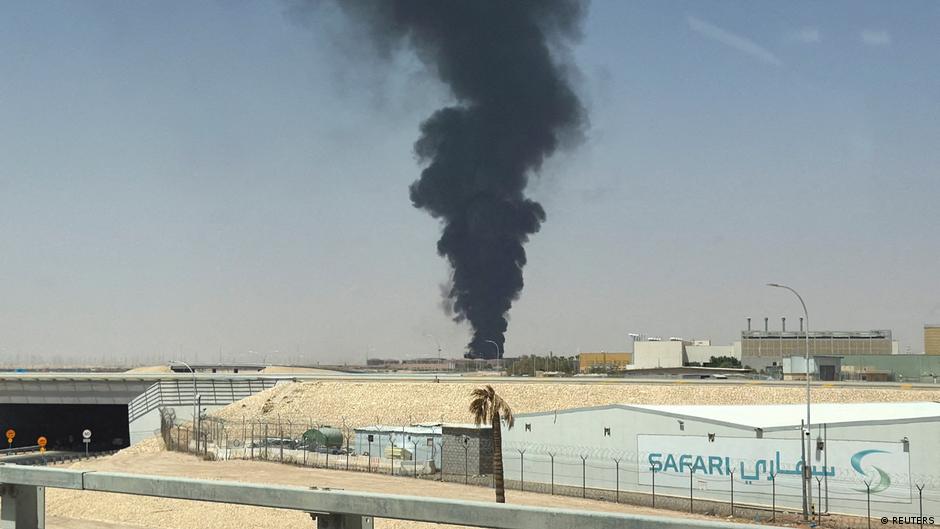
Saudi Arabia said its air defenses intercepted and destroyed a ballistic missile launched by Yemen’s Iran-aligned Houthi movement toward Riyadh, an escalation that places renewed financial and operational focus on the kingdom’s energy infrastructure and its largest company, Saudi Aramco.
The Saudi-led Coalition to Restore Legitimacy in Yemen said on Saturday, September 19, that the Houthis had attempted the previous night to strike the Saudi capital with a ballistic missile for the first time. Brigadier General Turki al-Maliki, the coalition’s official spokesman, said on X that the missile had been “intercepted and destroyed.”
An air raid alert was declared in Riyadh overnight, and some residents reported hearing an explosion. There were no immediate reports of casualties or damage. Later, a plume of smoke was seen near the airport. AFP, citing its correspondent, reported that a fuel tank belonging to Saudi Aramco, the kingdom’s largest oil company, was on fire and that the blaze had been extinguished. It remained unclear whether the fire was connected to the attempted missile strike. Aramco did not respond to journalists’ request for comment.
Energy infrastructure comes under closer market scrutiny
For investors and energy market participants, the attempted strike broadens the set of risks around Saudi Arabia’s export capacity, particularly as the kingdom has relied more heavily on alternative routes following severe disruption to tanker traffic through the Strait of Hormuz after the start of the U.S. and Israeli war with Iran.
Saudi authorities also said the Houthis had tried to attack civilian infrastructure, including facilities in the Red Sea port city of Yanbu, but that those attempts were thwarted. The Houthis, for their part, claimed they had used drones, cruise missiles and ballistic missiles to strike “important facilities” in Riyadh and Aramco infrastructure in Yanbu.
The Houthis said shipping through Bab el-Mandeb was “safe for all commercial vessels, except Saudi ones.”
The claims and counterclaims arrive at a sensitive moment for Saudi Arabia’s oil logistics. On September 11, the Financial Times reported that Saudi Arabia had halted operations on the East-West pipeline, which ends at the port of Yanbu, after an attack by drones launched from Iraqi territory. On September 18, Saudi Aramco notified at least two European refineries that it would not supply them with crude in October, Bloomberg reported.
According to Bloomberg, the pipeline was expected to be partially restarted within days and fully restored within a month and a half. That timeline is now likely to be watched closely by refiners, traders and investors assessing whether further attacks could affect Aramco’s delivery commitments, working capital planning and broader operational resilience.
Yanbu route takes on greater financial importance
The East-West pipeline has become increasingly important for Saudi Arabia since the war involving the United States, Israel and Iran made passage through the Strait of Hormuz significantly more difficult for tankers. Saudi Arabia increased exports through the pipeline as a way to preserve access to global markets and reduce exposure to Hormuz-related disruption.
In recent weeks, however, the capacity of that route has declined because of Houthi attacks on Saudi tankers in the Red Sea. In August, shipments through Yanbu stood at around 2.5 million barrels per day, the International Energy Agency said, the lowest level since 2013.
That figure is a key data point for the market because it indicates pressure not only on physical exports but also on the reliability of Saudi Arabia’s redundancy infrastructure. For Aramco, whose investor relations profile depends heavily on dependable production, logistics and dividend capacity, the sustained vulnerability of shipping routes may sharpen questions around supply continuity even when upstream production itself remains intact.
On September 11, Reuters and AFP reported that the Houthis had seized strategically important islands in the Bab el-Mandeb Strait, which connects the Red Sea with the Arabian Sea. About 12% of global freight traffic passes through the strait, including oil trade. The route has become especially important for Saudi Arabia after the closure of Hormuz.
The Houthis also gained control of the port of Mocha on Yemen’s Bab el-Mandeb coast, according to reports that emerged the day before the Riyadh incident. Reuters reported that the Houthi advance was being directed by Iran’s Islamic Revolutionary Guard Corps. Sources in Tehran said Iran was seeking to open a new front in its confrontation with the United States.
The Saudi-led coalition also said on September 16 that the Houthis had attacked Mecca, Islam’s holiest city, with a drone, which it said was shot down on approach. The Yemeni rebels denied the accusation.
For financial reporting purposes, the latest incident underscores the expanding range of operational risks surrounding Saudi oil flows: missile defense costs, insurance premiums, refinery supply contracts, tanker routing, port utilization and the timing of pipeline restoration. No casualties or material damage in Riyadh had been reported, but the incident adds to a sequence of attacks that investors are likely to evaluate in terms of potential effects on Aramco’s October supply obligations and Saudi Arabia’s ability to sustain exports through Red Sea infrastructure.