Georgia Opposition Launches New Protests as Political Risk Deepens
A planned Nov. 28 rally and a court case targeting opposition parties add to governance risks facing Georgia’s investment outlook.
Georgia’s opposition leaders have announced a new wave of protests against the ruling Georgian Dream party, adding to political uncertainty that could weigh on investor confidence, business planning and the country’s longer-term financial outlook.
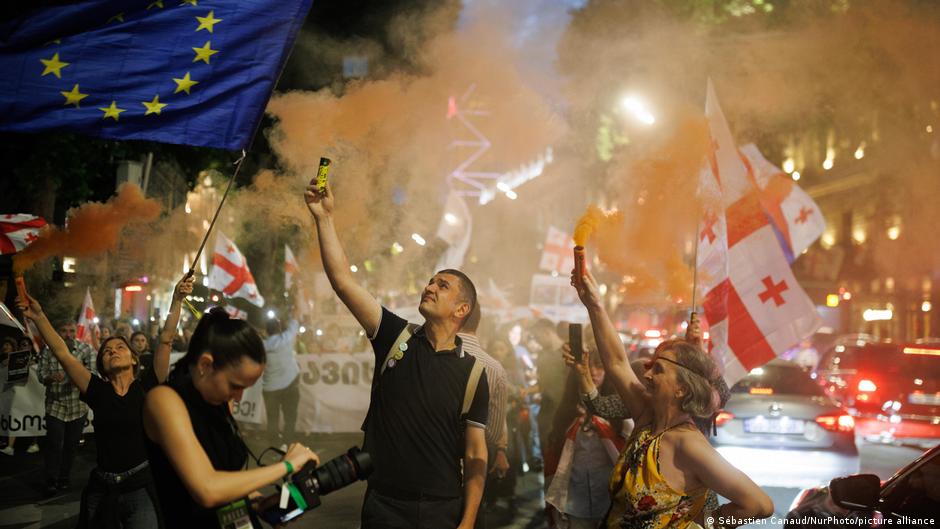
Thousands of demonstrators marched through Tbilisi on Sunday, Oct. 25, as Georgia’s Constitutional Court considers a lawsuit seeking to ban opposition parties. The protest was organized by opposition and civil society representatives under the slogan “Georgia Without Ivanishvili,” referring to Bidzina Ivanishvili, the billionaire founder of Georgian Dream.
Participants walked from Tbilisi State University toward Rustaveli Avenue, according to Kavkazsky Uzel. Demonstrators carried the flags of Georgia, Ukraine and the European Union. The publication also reported a large presence of security personnel at the event.
Although the demonstration was political rather than economic, the renewed confrontation raises questions relevant to companies, creditors and investors assessing Georgia. The court proceedings, restrictions alleged by opposition leaders and the prospect of further mass protests may increase uncertainty over governance, Georgia’s relations with the European Union and the policy environment in which businesses operate.
Opposition Targets Nov. 28 for Major Rally
Nika Gvaramia, leader of the Coalition for Change, described Sunday’s march as the beginning of a new protest wave. Opposition groups are seeking a major turnout on Nov. 28, the second anniversary of the start of mass protests in Georgia, or in the days that follow.
“We are starting today, and we definitely need a culmination, whether it is on Nov. 28 or in the following days. It is important that there are very many of us on the 28th, so that the wind cannot extinguish the fire,” Gvaramia said, as quoted by Kavkazsky Uzel.
Gigi Tsereteli, leader of European Georgia, who also attended the march, said a large and important demonstration was planned for Nov. 28. He argued that Georgia had shifted from being a leading country on the path toward European integration to becoming an outsider.
“What is happening in Georgia today in terms of the destruction of democracy and disruption is truly unimaginable against the background that we were a champion country on the path of European integration, and today we are outsiders,” Tsereteli said, according to Georgia Online. He added that political parties were being banned, political life was effectively being restricted and political prisoners represented another major challenge.
The opposition’s statements come as the Constitutional Court examines the case concerning a possible prohibition on opposition parties. Such proceedings could reshape the political landscape and intensify scrutiny of Georgia’s institutional framework. For financial stakeholders, the central issue is not an immediate change in reported corporate earnings or public balance sheets, but the potential for prolonged instability to influence capital allocation, risk assessments and investment decisions.
EU Dispute Has Sustained Political Crisis
Georgia’s mass protests began in spring 2024 over the law on “foreign agents.” The demonstrations intensified after Georgian Dream won the parliamentary election and developed into a broader crisis in November 2024, when the authorities decided to postpone negotiations on the country’s accession to the European Union until 2028.
The protests have included clashes with police. Security forces have dispersed demonstrators using tear gas and water cannon. The history of confrontation gives the planned Nov. 28 rally added significance, particularly if turnout is large or the authorities again deploy substantial security resources.
Georgia’s European integration trajectory is an important element of the country’s broader economic narrative. Any prolonged deterioration in relations with the EU, coupled with domestic institutional uncertainty, may become part of the risk framework used by international investors and companies when reviewing exposure to the country. The source report did not provide data on government finances, corporate results, market movements or changes to investment flows.
The immediate focus will therefore remain on the Constitutional Court’s consideration of the lawsuit, the authorities’ response to the renewed demonstrations and the opposition’s ability to mobilize supporters for Nov. 28. Those developments will help determine whether Sunday’s march marks a sustained escalation of the political crisis or a more limited phase of protest activity.