Yuri Dmitriev Returned to Penal Colony Without Stroke Diagnosis
The imprisoned historian was sent to a prison hospital with symptoms of a possible stroke, but supporters say doctors lacked diagnostic equipment.
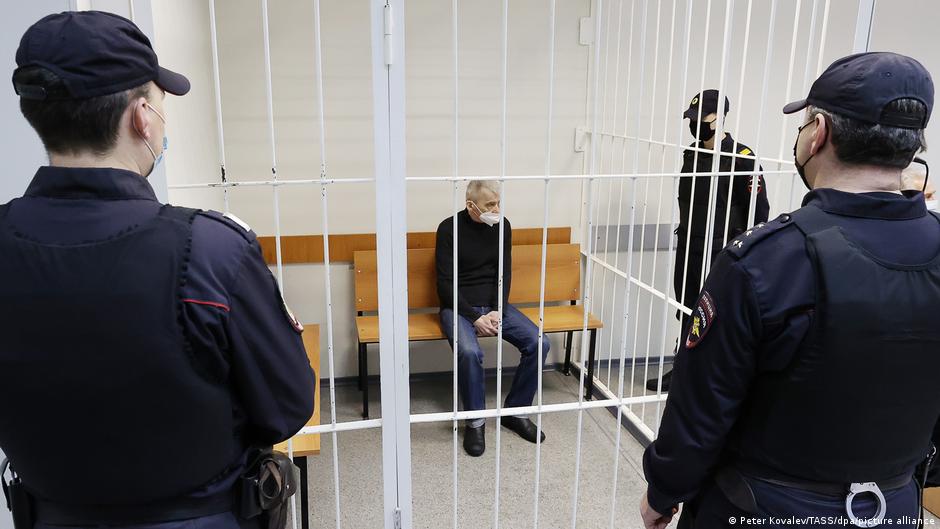
Russian historian Yuri Dmitriev, the former head of Memorial in Karelia, has been returned from a prison hospital to his penal colony without a diagnosis after being transferred with signs of a possible stroke, according to the rights project For Human Rights.
The group reported the development on Telegram on Tuesday, October 13, citing an unnamed representative of Dmitriev’s support group. The account raises renewed questions about the cost, oversight and risk management of medical care inside Russia’s prison system, where access to diagnostic equipment can determine whether an inmate receives timely treatment or is sent back to detention without clarity about a serious health episode.
“His condition is not very good. There was a suspicion of a stroke, but no diagnosis was made: the hospital has no diagnostic equipment,” the representative said, according to the rights group.
The representative said Dmitriev received a course of injections, but that it was not known what medication had been administered. She also said he had been prescribed bed rest until October 28, but that colony staff were allegedly unaware of the order and were not allowing him to remain lying down. Later, she added that the colony may have received the information about bed rest.
Dmitriev was urgently hospitalized on September 25 from Penal Colony No. 18 in Potma, Mordovia, to a medical correctional facility in the settlement of Barashevo. The online outlet Current Time reported that Dmitriev had severe weakness, impaired coordination and was unable to stand without assistance.
Prison Healthcare and Institutional Exposure
For a financial reporting readership, the case is not an earnings story in the conventional corporate sense, but it does point to institutional liabilities that are familiar to investors, public-sector analysts and governance specialists: inadequate infrastructure, opaque reporting lines and rising reputational costs. The reported absence of equipment to diagnose a possible stroke suggests a gap between formal medical referral and the operational capacity of the prison healthcare system to perform basic risk assessment.
The claims also highlight a lack of transparency in documentation and communication. The support-group representative said Dmitriev received injections without the family or supporters knowing what was administered, while the colony allegedly did not initially recognize the prescribed bed rest. In balance-sheet terms, these are not recorded liabilities, but they may become political, legal and diplomatic liabilities when they involve prisoners whose cases are already under international scrutiny.
The representative also said Dmitriev had been placed in a punishment cell several times, citing incidents such as an unbuttoned top shirt button, sitting on a bed and feeding a cat. Those details, while administrative in form, carry financial-reporting relevance when viewed through a governance lens: repeated disciplinary measures can affect health, legal exposure and outside assessments of institutional conduct.
A Long-Running Case With International Costs
Dmitriev is known for compiling and publishing Books of Remembrance for victims of political repression in Karelia in the 1930s and 1940s, as well as materials on the history of the construction of the White Sea-Baltic Canal. He also discovered mass burial sites of repression victims in Sandarmokh and Krasny Bor.
His criminal prosecution began in 2016, when the first case was opened against him on suspicion of producing pornographic images of his adopted daughter. A court acquitted him, but a new case was opened in 2018.
On July 22, 2020, the Petrozavodsk court sentenced Dmitriev to 3.5 years in a strict-regime penal colony on charges of sexual violence against a minor. In September 2020, the Supreme Court of Karelia toughened the sentence, imposing 13 years in a strict-regime colony. Dmitriev was also accused of producing child pornography, committing lewd acts and illegally storing a weapon. On December 27, 2021, the Petrozavodsk City Court issued a final sentence for Dmitriev, then 65, of 15 years in a strict-regime colony, taking into account the previously imposed term.
Dmitriev has denied guilt. On March 15, 2022, the Supreme Court of Karelia rejected his appeal. His supporters have argued that the prosecution is connected to his human rights activity and his work restoring the memory of victims of repression. The European Union, as well as scholars and artists from different countries, have called for Dmitriev’s release.
In March 2026, the European Court of Human Rights in Strasbourg ordered Russia to pay Dmitriev 2,000 euros in compensation for moral harm caused by excessively long pre-trial detention and the absence of a fair trial. Kremlin spokesman Dmitry Peskov, commenting on the ECHR ruling at the time, said Moscow did not recognize it.
The compensation amount is modest in financial terms, but the ruling adds to the accumulated institutional cost of the case. For governments and state-linked institutions, such judgments can function much like contingent liabilities: disputed, sometimes unpaid, but still visible to external observers assessing rule-of-law risk, sanctions exposure and international standing.
Dmitriev’s return to the colony without a diagnosis now puts the focus back on immediate custodial responsibility. The central unresolved issue is not only whether he suffered a stroke or another serious condition, but whether the prison medical system had the equipment, procedures and reporting discipline to evaluate the risk. For a 15-year sentence being served under strict-regime conditions, that question is material to his health, to the institutions responsible for him and to the broader accounting of Russia’s human rights obligations.